Biomimicry in Architecture
Nature has always influenced architecture, but biomimicry takes this relationship a step further. Rather than simply imitating natural forms, biomimicry studies how organisms and ecosystems function and applies those principles to solve design challenges. As architecture moves toward more sustainable and efficient solutions, biomimicry is becoming an increasingly valuable design approach.
What is Biomimicry?
Biomimicry is the practice of learning from nature’s strategies and applying them to human design. Popularized by Janine Benyus, the concept encourages designers to view nature as a source of tested solutions developed over billions of years of evolution.
In architecture, biomimicry goes beyond aesthetics. It focuses on creating buildings that perform more efficiently by adopting nature-inspired systems and processes.
Origins of Biomimicry in Architecture
Architects have long looked to nature for inspiration. The work of Antoni Gaudí, particularly the branching columns of Sagrada Família, reflects an early understanding of nature’s structural efficiency.
Modern biomimicry, however, emphasizes function rather than form. The goal is not to make buildings look like nature, but to make them work like nature.
Applications of Biomimicry in Architecture
- Passive Cooling and Ventilation
One of the most cited examples is the Eastgate Centre, whose ventilation system was inspired by termite mounds. By regulating airflow naturally, the building significantly reduces its dependence on mechanical cooling.
- Responsive Building Facades
Plants continuously adapt to sunlight and environmental conditions. Similarly, modern building facades can adjust shading, light penetration, and heat gain to improve energy efficiency and occupant comfort.
- Efficient Structural Design
Nature achieves maximum strength with minimum material. Architects often study bones, trees, and natural growth patterns to develop lightweight and structurally efficient building systems.
- Water Management Solutions
Certain plants and insects are capable of collecting moisture from the atmosphere. These strategies are inspiring innovative rainwater harvesting and water conservation systems in buildings.

Benefits of Biomimicry in Architecture
Improved Sustainability:
Biomimicry encourages designs that work with natural processes rather than against them.
Benefits include:
- Lower energy consumption
- Reduced resource use
- Improved water management
- Lower environmental impact
Enhanced Building Performance:
Natural systems are highly optimized.
Applying biological principles often results in:
- Better thermal comfort
- Improved ventilation
- Greater structural efficiency
- Reduced maintenance costs
Innovation in Design Thinking
Biomimicry pushes architects beyond conventional design solutions.
Instead of asking:
“What building should we design?” Architects begin asking: “How does nature solve this problem?”
This shift often generates more innovative and resilient outcomes.
Greater Resilience
Natural systems adapt, recover, and evolve.
Buildings inspired by these principles can become:
- More climate-responsive
- Better equipped for environmental changes
- More adaptable over time
Resilience is increasingly becoming a critical design objective in the face of global climate challenges.
Challenges of Biomimicry in Practice
Despite its potential, biomimicry is not without challenges.
Interdisciplinary Knowledge Requirements
Successful biomimicry often requires collaboration between:
- Architects
- Biologists
- Environmental scientists
- Engineers
- Material researchers
Understanding biological systems at a deep level can be complex.
Cost and Technology Constraints
Some biomimetic technologies require advanced materials, fabrication methods, or digital modeling tools, which can increase project costs.
Risk of Superficial Application
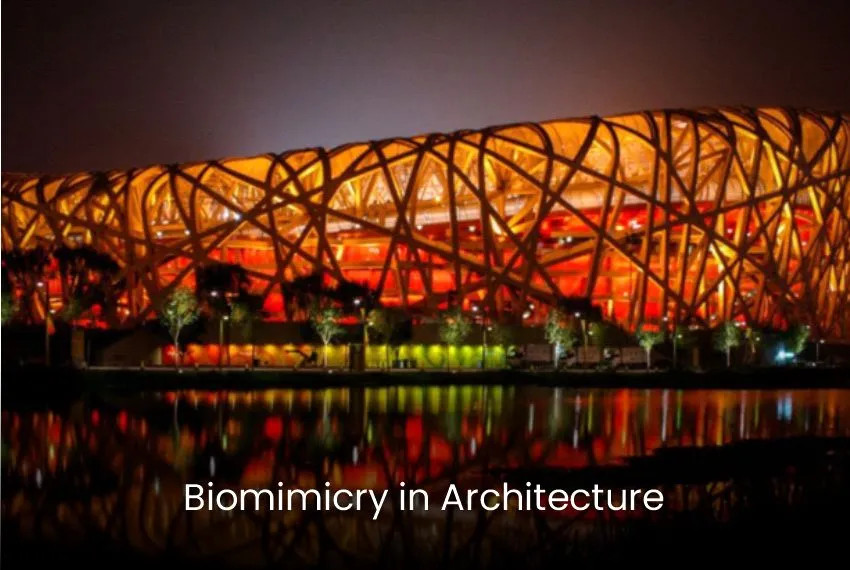
Many projects claim to be biomimetic simply because they resemble natural forms. True biomimicry focuses on performance and function rather than appearance alone. A building shaped like a leaf is not necessarily biomimetic unless it also incorporates biological principles that improve performance.

Conclusion
Biomimicry represents a fundamental shift in how architects approach design. Rather than viewing nature as a source of aesthetic inspiration alone, it positions nature as a mentor, model, and measure for innovation.
By studying the intelligence embedded within biological systems, architects can create buildings that are more efficient, resilient, and environmentally responsible. From termite-inspired ventilation systems to adaptive facades and ecosystem-based planning, biomimicry demonstrates that many of the solutions to today’s design challenges already exist in the natural world.
As sustainability becomes an essential priority rather than an optional consideration, biomimicry offers a compelling pathway toward architecture that is not only inspired by nature but also works in harmony with it.
For architects and design professionals, the question is no longer whether nature can inspire better buildings-it is how deeply we are willing to learn from it.